A few years ago, I was advising on a $180 million acquisition that was about to fall apart.
The buyer had a signed letter of intent. The seller had agreed to participate in the financing, including rolling equity into the transaction. A lender was prepared to provide $75 million. Most of the pieces were in place.
But with roughly 48 hours remaining, the buyer still hadn’t secured the final portion of the equity needed to close.
The deal didn’t happen.
I’ve spent nearly two decades buying businesses and participating in acquisitions, and that transaction reinforced something I’ve come to appreciate about the M&A market: The ability to identify and acquire a valuable business doesn’t always reside with the people who have the capital to buy it.
Sometimes the missing ingredient is a relatively small portion of the purchase price. Other times, it’s an experienced operator who can turn an overlooked business into something much more valuable. An increasingly important group of acquisition entrepreneurs is building a model around that separation. They’re called independent sponsors, and they’re changing how businesses are acquired, financed, and grown.
Find the Business First. Raise the Capital Second.
Traditional private equity firms generally raise committed capital before acquiring companies. Investors contribute to a fund, and the fund’s managers deploy that money across a portfolio of acquisitions.
Independent sponsors reverse the sequence.
An independent sponsor is an acquisition professional or team that identifies a business to buy, negotiates the transaction, and then raises the equity required to complete that specific acquisition. The sponsor typically leads the investment and oversees the company’s post-acquisition strategy. Historically, these professionals were called fundless sponsors because they didn’t have committed investment funds.
Rather than asking investors to commit capital to a portfolio of companies that haven’t been identified yet, an independent sponsor can present a specific acquisition opportunity. Investors evaluate the business, its valuation, the proposed financing, and the team responsible for creating value.
The sponsor contributes acquisition expertise. Investors provide much of the capital. Together, they can pursue opportunities that might be beyond either party’s reach independently.
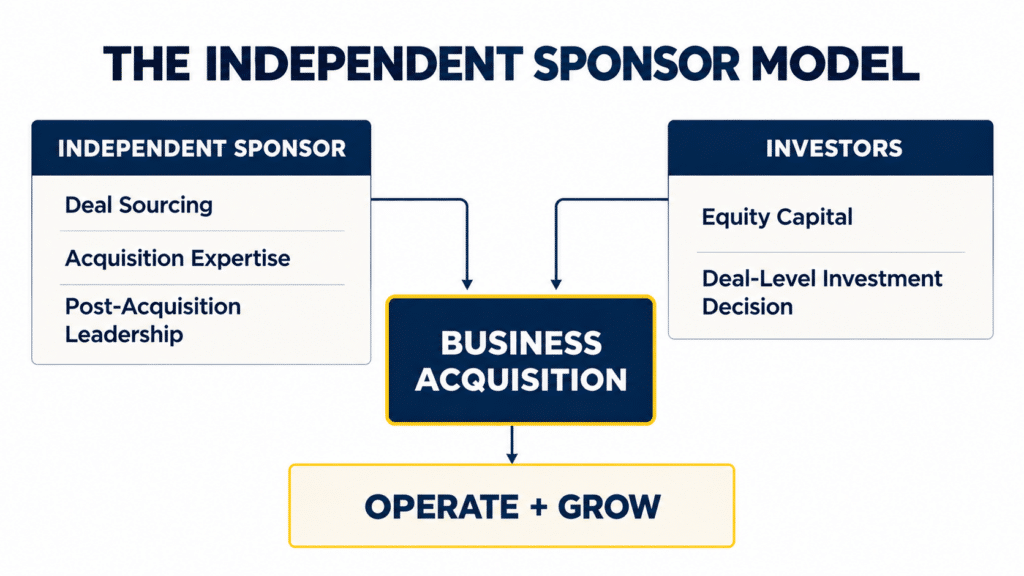
Sponsors typically participate in the economics through a combination of acquisition fees, ongoing management fees, and a share of investment profits known as carried interest or the promote. The precise terms are negotiated with investors, but the idea is that the sponsor can earn meaningful ownership upside without contributing the majority of the acquisition capital.
And the model is growing quickly. According to Build Capital’s Q4 2026 research, Financing the Crossing, annual independent sponsor transaction volume has nearly tripled since 2021, reaching an estimated $15 billion in 2025. Independent sponsors now complete approximately 500 platform acquisitions annually, representing an estimated 11% of U.S. lower-middle-market buyouts.
These are estimates derived from industry data rather than a complete census, but the direction is clear. More experienced acquisition professionals are choosing to pursue ownership without first establishing traditional private equity funds. The businesses they’re pursuing help explain why.
Buy in One Market, Then Sell in Another.
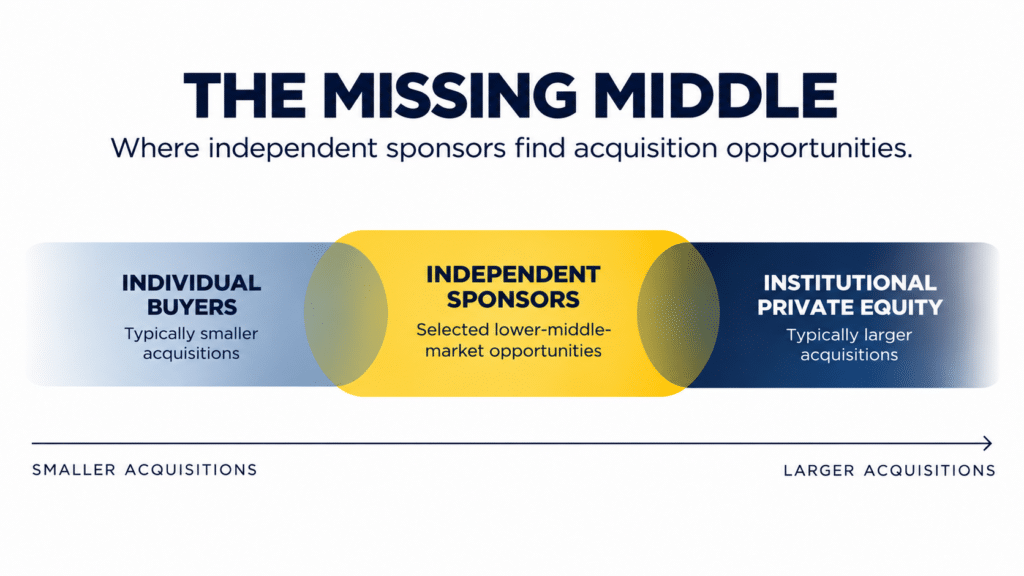
One of the most interesting opportunities in business acquisitions exists between two established buyer markets.
On one side are individual acquisition entrepreneurs, often pursuing businesses that can be financed through personal equity, SBA loans, seller financing, and smaller investor groups.
On the other are institutional private equity firms, which generally need larger transactions to justify their investment teams, operating infrastructure, and fund economics.
Between them sits a category of established companies that can be too large for many individual buyers and too small for major private equity firms.
I’m particularly interested in businesses generating approximately $4 million to $10 million in EBITDA. These companies may have operated profitably for decades. They have customers, employees, established products, and proven demand. But many have never had institutional ownership or the management infrastructure that comes with it.
An experienced sponsor can acquire one of these businesses, improve its operations, strengthen management, and grow earnings. What’s particularly interesting is what happens when that business becomes large enough to attract a different group of buyers. In Financing the Crossing, our team describes this as “the crossing.”
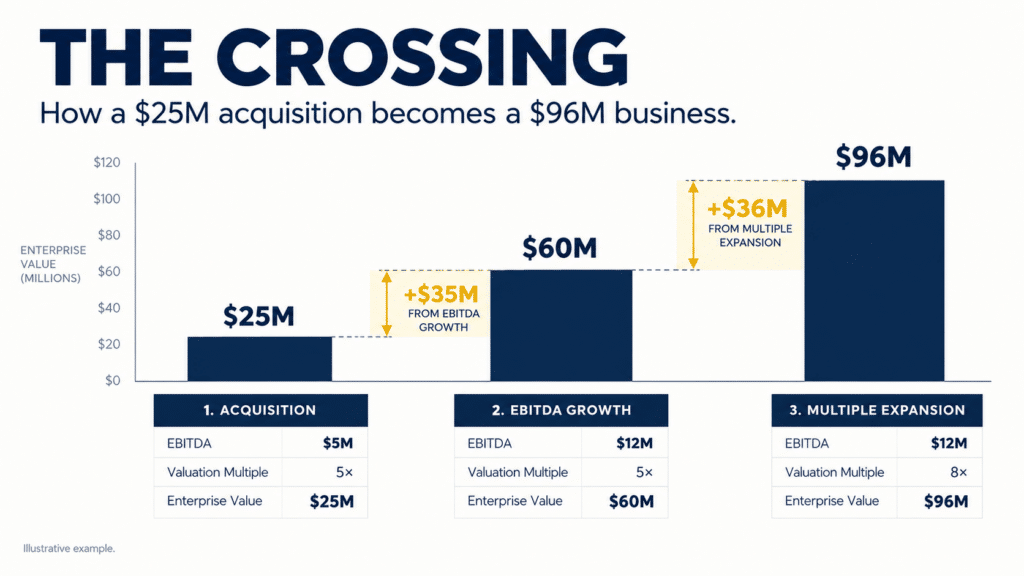
Consider a hypothetical coatings manufacturer generating $5 million in EBITDA. Its founder is ready to retire, and the business sells for $25 million, or 5× earnings.
Over the next five years, an experienced sponsor:
- Installs a CFO and strengthens financial oversight.
- Improves systems and operational processes.
- Addresses customer concentration.
- Completes an acquisition.
- Grows EBITDA from $5 million to $12 million.
Now the company looks very different to potential buyers. Its earnings are larger. Its management infrastructure is stronger. Its risks are better understood. And it’s big enough to attract institutional private equity firms and strategic acquirers that may never have considered the original business.
If it sells for 8× EBITDA, its enterprise value reaches $96 million. The value creation comes from two sources: the company generates more earnings, and buyers are willing to pay a higher valuation multiple for those earnings.
The sponsor has effectively moved the company from one acquisition market into another.
Historical transaction data suggests that multiple expansion has also been a meaningful source of value in independent sponsor acquisitions. A 2026 study from the University of North Carolina’s Institute for Private Capital, Independent Sponsors: Investment Characteristics and Performance, examined 846 independent sponsor transactions entered between 2002 and 2025. Among the transactions with relevant valuation data, the median entry multiple was 5.5× EBITDA, while the median exit multiple was 8.0×. More than 75% experienced multiple expansion.
Those results don’t mean every sponsor can count on selling at a higher multiple. They do illustrate why the transition from a smaller, less institutional business to a larger, professionally managed company can be so valuable. And they reveal an important distinction about business growth. Increasing earnings is one way to create value. Changing the universe of buyers willing to acquire your company can create value, too.
A Good Deal Still Needs the Last Check
Of course, finding an attractive acquisition is only half the challenge. Independent sponsors still have to finance it. And because they typically secure committed capital for each acquisition rather than drawing from an existing fund, they’re working against a closing deadline.
Consider an illustrative $20 million acquisition.
A bank might provide $10 million in senior debt. Family offices or other co-investors contribute another $5 million in equity. The sponsor and seller provide $1.5 million through their own participation. That leaves $3.5 million still needed to close.
The buyer has assembled $16.5 million of a $20 million transaction. Yet without the remaining capital, the acquisition may be impossible. This is where gap equity comes in.
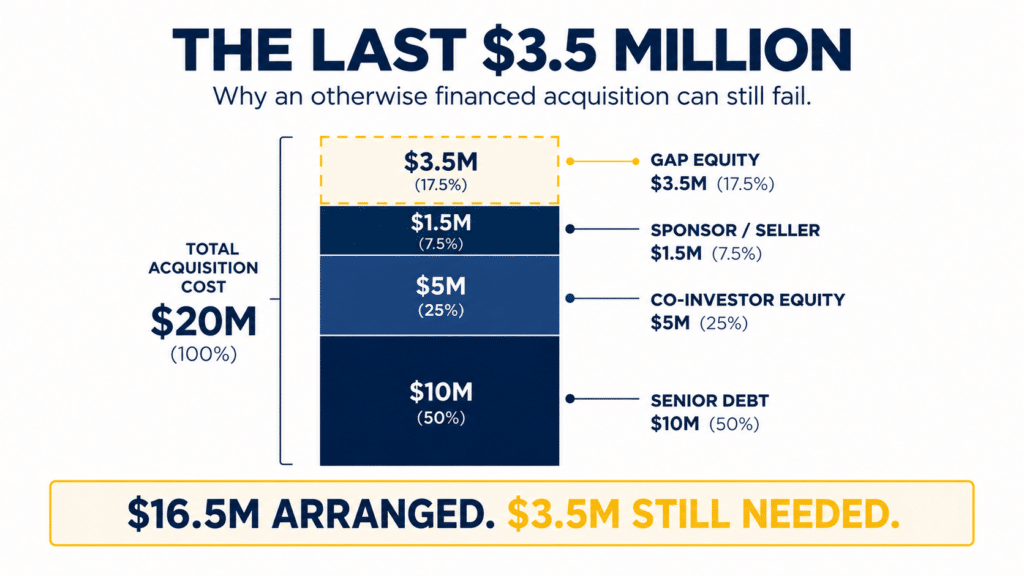
Gap equity is the additional equity financing required to complete an acquisition after other capital sources have been arranged. It can be structured in different ways, including preferred equity, depending on the transaction and the investors involved. It’s a particularly challenging portion of the independent sponsor financing process.
Build Capital estimates that roughly half of sponsor acquisitions require a gap-equity tranche. Across the market, the firm estimates annual demand for this capital at approximately $1.2 billion, with $500 million to $1 billion potentially going unmet. Those figures are proprietary estimates, but they help explain an important feature of the model.
The largest financing source isn’t necessarily the hardest to secure. Banks have established processes for underwriting acquisition loans. Family offices and private equity investors regularly evaluate equity opportunities. But the final check often needs to come from an investor willing to assess a specific transaction, negotiate terms, and commit capital within a limited window.
Interest also isn’t the same thing as commitment. I’ve seen what happens when a buyer has a willing seller, substantial financing arranged, and a deal that still can’t cross the finish line. The independent sponsor model creates opportunities by allowing acquisition professionals to pursue businesses without committed funds. But that flexibility also makes financing certainty one of the model’s greatest challenges.
The sponsor needs more than access to investors. The sponsor needs investors who can make decisions in time to close.
Investors Are Backing the Sponsor as Much as the Business
There’s an important qualification to all of this. When I say you don’t need all the money to buy a business, I’m not suggesting that someone with no acquisition experience can find a company and expect investors to finance it.
The independent sponsor model is predominantly being pursued by experienced professionals. In the UNC study, 88% of sponsors had prior private equity experience, 71% had worked in investment banking, and 63% brought operational expertise. Approximately two-thirds of transactions involved sponsors completing their third deal or later. These are often people who already know how to evaluate acquisitions, negotiate transactions, structure financing, and improve companies. They’re choosing to apply those skills independently.
That distinction is central to understanding why investors participate.
A sponsor might identify an overlooked business in an industry they know exceptionally well. They might recognize operational improvements that aren’t obvious to a financial buyer. They might have relationships with management talent capable of taking the company to its next stage. The investor is evaluating the business, but also the person or team responsible for turning the acquisition thesis into an operating result.
The historical performance data helps explain the appeal.
The UNC study reported a 23.8% median gross equity IRR among its seasoned independent sponsor investments. Average gross equity IRR was 29.3%, exceeding the average of matched buyout benchmarks by 11.4 percentage points. However, there’s another finding I consider just as important. Independent sponsor investments had a 23.5% loss incidence, compared with 21.6% for comparable buyouts. The difference wasn’t statistically significant.
In other words, the observed outperformance came primarily from larger positive outcomes rather than a lower frequency of losses.
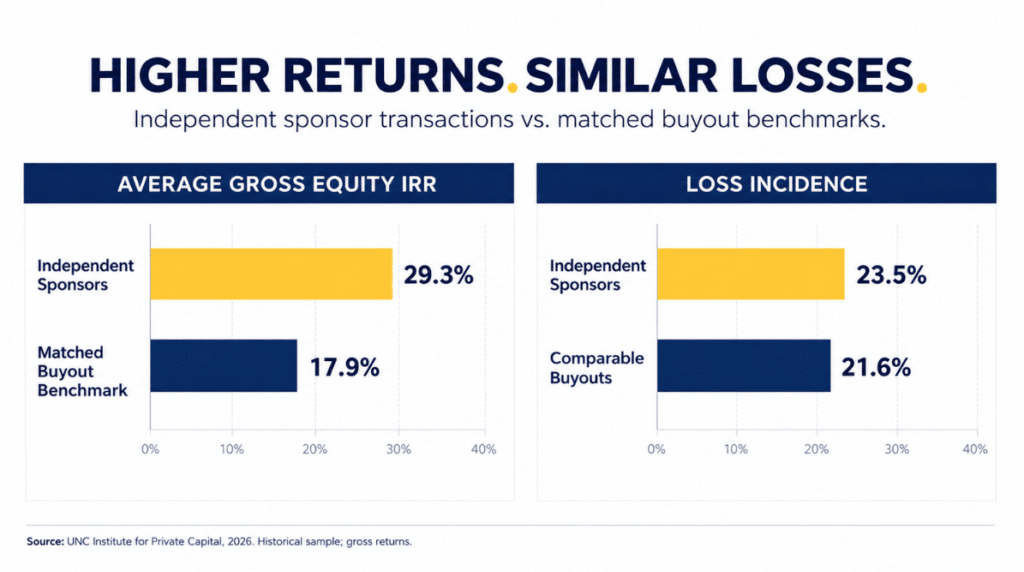
That has implications for anyone investing alongside sponsors. The model itself doesn’t guarantee superior returns. The quality of the acquisition, the price paid, the financing structure, and the sponsor’s ability to improve the company still matter enormously.
The study also relied on voluntarily submitted transactions, so its historical results shouldn’t be treated as a forecast for the broader market. What it does demonstrate is that independent sponsorship has become a meaningful acquisition strategy with enough history to evaluate its performance. The people behind those transactions are a major part of the equation.
The Next Evolution of Buy Then Build
When I wrote Buy Then Build, the central idea was that entrepreneurs could improve their odds of success by acquiring an established, cash-flowing business rather than starting from zero.
I still believe that.
But after years of acquiring companies, operating them, advising on transactions, and investing alongside other entrepreneurs, I’ve come to see another possibility. You don’t necessarily need to own and operate every business yourself to participate in the value created through acquisition entrepreneurship. And experienced acquisition professionals don’t necessarily need to supply all the capital required to pursue larger opportunities.
Independent sponsors bring those two ideas together.
They create a way for investors to back capable acquisition teams and for those teams to pursue businesses that might otherwise remain beyond their financial reach. The opportunity becomes particularly interesting when those teams can acquire companies in one market, build them into stronger enterprises, and eventually sell them into another.
That’s the next evolution of Buy Then Build: applying the principles of acquisition entrepreneurship at a larger scale, with capital and operating expertise working together.
If you’re interested in investing alongside experienced acquisition entrepreneurs, Build Capital is pursuing opportunities to acquire and grow established businesses. Learn more about our investment strategy and upcoming opportunities through our Build Capital investor portal.